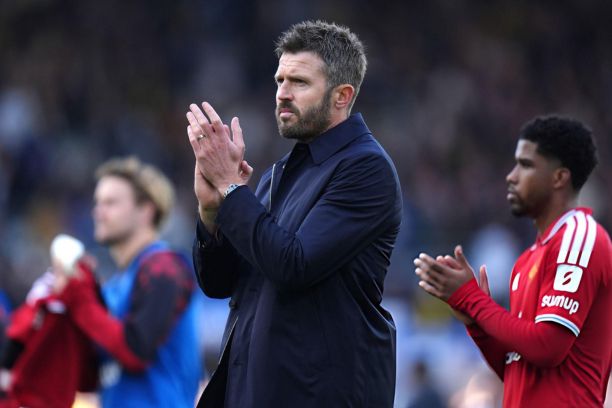
The pressure is mounting on Michael Carrick as Manchester United’s disappointing start to the 2026/27 season raises serious questions about his ability to manage one of football’s biggest clubs.
With just one victory from their opening seven league matches, the Red Devils find themselves in unfamiliar territory, struggling for consistency, confidence, and tactical identity.
What initially looked like a promising managerial appointment is rapidly becoming a test of Carrick’s experience, leadership, and adaptability.
As frustration grows around Old Trafford, an uncomfortable question demands attention: is the former United midfielder genuinely equipped to restore the club’s fortunes, or has the job become too big for him?
Manchester United’s Disastrous Start to the 2026/27 Season
For a club with Manchester United‘s history, seven points from seven matches represents an alarming return. The Red Devils entered the season hoping to build on their remarkable third-place finish during the previous campaign. Instead, they have fallen into the bottom half of the table, leaving supporters wondering how optimism turned into uncertainty so quickly.
United’s results tell a troubling story. Their solitary league victory came in an emphatic 5-2 win over Ipswich Town in August. Since then, the team has struggled to turn promising moments into convincing performances, suffering against Manchester City and settling for frustrating draws against Everton, Fulham, Tottenham Hotspur, and Leeds United.
The situation has placed Michael Carrick under increasing scrutiny. As of October 18, United had managed one win, four draws, and two defeats from seven Premier League fixtures, collecting seven points from a possible 21. That represents an average of exactly one point per game, a return that would be unacceptable if sustained across a full campaign.
The latest setback came at Elland Road, where United surrendered a lead and finished with a 1-1 draw against Leeds. Bryan Mbeumo opened the scoring, but Dominic Calvert-Lewin equalised, leaving the visitors with another disappointing result.
Carrick described elements of the performance as encouraging and suggested it could provide a fresh beginning. However, supporters have heard similar promises of improvement throughout the club’s difficult post-Ferguson years.
The concern is not simply that United are dropping points. It is that they are struggling to demonstrate the authority, defensive reliability, and attacking consistency expected from a club competing domestically and in Europe.
When a team with Champions League ambitions begins a season in 13th position after seven matches, questions about the manager become inevitable.
From Promising Appointment to Mounting Pressure
When Michael Carrick returned to Manchester United as head coach in January 2026, his appointment represented more than a managerial change. It offered supporters the possibility of reconnecting with a figure who understood the club’s identity, traditions, and expectations.
Carrick had enjoyed an outstanding playing career at Old Trafford, becoming an important member of Sir Alex Ferguson’s successful teams. His intelligence, positional awareness, and ability to control matches from midfield made him one of the most influential English players of his generation.
Those qualities created understandable optimism about his potential as a manager.
More importantly, his initial results justified that optimism. Carrick took charge during a difficult period and helped transform the team’s fortunes, overseeing 11 victories in 16 league matches. United secured Champions League qualification, finished third, and appeared to rediscover some of the resilience that supporters had desperately wanted to see.
Victories over Manchester City and Arsenal early in his return strengthened the argument that he could succeed permanently.
In May 2026, the club rewarded him with a contract running until 2028. It was a statement of confidence in a coach who appeared capable of bringing stability after years of managerial upheaval.
However, managing a club successfully for several months and sustaining that success over multiple seasons are different challenges.
A short-term appointment can benefit from renewed energy, improved morale, and the psychological impact of a fresh voice. A permanent manager must establish a system that continues producing results after opponents have studied it and the initial excitement has faded.
That is the challenge Carrick now faces.
His early achievements remain significant, but past success cannot indefinitely protect him from criticism. Football management rewards progress, and United’s current trajectory suggests that the improvements made last season have not carried into the new campaign.
The question is whether Carrick can rediscover that winning formula or whether his initial success created unrealistic expectations about his readiness for the position.
One Win in Seven: What the Results Really Reveal
Football managers are ultimately judged by results, but numbers become more meaningful when examined alongside performances.
United’s record of one win from seven matches is concerning enough. Yet the deeper problem is their repeated inability to manage important moments during games.
Against Everton, Fulham, Tottenham, and Leeds, the team failed to secure maximum points. These were opportunities to build momentum, but each disappointing outcome increased the pressure surrounding Old Trafford.
For Michael Carrick, the challenge is finding a convincing explanation for why his players are struggling to translate competitive performances into victories.
The draws against Tottenham and Leeds are particularly revealing.
Against Tottenham, United appeared positioned to collect three points after taking the lead through Bryan Mbeumo. Their advantage became even more significant when Rodrigo Bentancur received a red card late in the match.
Playing against ten men should have provided an opportunity to control possession, manage the remaining minutes, and protect the result.
Instead, Dominic Solanke scored a stoppage-time equaliser, leaving United with another two points dropped.
The subsequent match against Leeds followed a different pattern but produced the same frustrating outcome. United demonstrated greater organisation and attacking intent, yet failed to protect another narrow advantage.
These repeated setbacks suggest that the team’s difficulties extend beyond isolated individual mistakes.
Successful teams understand how to win matches when they are not performing at their best. They remain compact, manage possession intelligently, and minimise unnecessary risks during crucial stages.
United have struggled to develop those habits consistently.
There is also a psychological dimension. Repeatedly dropping points from promising positions can affect a squad’s belief, particularly when confidence is already fragile.
Players may become hesitant when protecting a lead, while opponents gain confidence from knowing that United remain vulnerable.
Seven matches is still a relatively small sample, and there is time for improvement. Nevertheless, the early evidence indicates that the club has significant weaknesses to address.
Unless Carrick finds solutions quickly, the gap between United and their rivals could become increasingly difficult to close.
Is Michael Carrick’s Tactical Approach the Problem?
Tactics provide one of the clearest ways to evaluate a manager’s influence. While players are responsible for their individual performances, the coaching staff must establish a structure that maximises their strengths and reduces their weaknesses.
For Michael Carrick, tactical consistency has become an important area of concern.
United have generally operated with a back four and variations of a 4-2-3-1 system, but their midfield combinations, pressing intensity, and attacking relationships have fluctuated.
At their best, the team can move the ball quickly, create opportunities between defensive lines, and use the pace of its attacking players to threaten opponents.
At their worst, United look disconnected, with significant spaces appearing between midfield and defence.
The challenge is creating a system that remains effective regardless of whether the team is dominating possession or defending for extended periods.
Carrick’s playing background suggests a strong understanding of positional football. As a midfielder, he was excellent at recognising passing angles and controlling the rhythm of matches.
However, translating that understanding into a reliable managerial framework requires more than football intelligence.
Players need clarity about their responsibilities during every phase of possession. Full-backs must understand when to advance. Midfielders must know when to provide defensive cover. Attackers need coordinated movements that create space instead of congesting the same areas.
United’s performances have sometimes suggested that these relationships are still developing.
There have been encouraging moments, especially when Carrick has adjusted his midfield structure to improve balance. The Leeds match, for example, offered signs that a more compact setup could provide greater stability.
Nevertheless, an effective tactical identity cannot depend on occasional improvements.
The manager must develop a coherent approach that players understand instinctively, particularly during high-pressure situations.
The most worrying possibility is not that Carrick lacks tactical ideas, but that he has yet to establish which ideas are best suited to the squad.
If those uncertainties persist, United may continue producing isolated promising performances without developing the consistency required to challenge stronger teams.
Midfield Balance Remains a Serious Concern
Given his reputation as a midfielder, perhaps the greatest irony of Michael Carrick‘s current difficulties is United’s struggle to control the centre of the pitch.
During his playing career, Carrick excelled at establishing rhythm and protecting his defenders through intelligent positioning. His teams often benefited from his ability to identify danger before opponents could exploit it.
Modern football demands similar qualities, although the tactical responsibilities of central midfielders have become increasingly complex.
A successful midfield must progress possession, support attacking transitions, protect defensive spaces, and help the team recover the ball quickly.
United have not always balanced these requirements effectively.
Bruno Fernandes remains an important creative influence, but his attacking instincts mean the players around him must provide sufficient defensive security.
Kobbie Mainoo offers technical ability and composure, while Youri Tielemans provides passing quality and experience. Other midfield options offer different physical and defensive attributes.
The difficulty lies in finding combinations that complement one another.
When too many players advance simultaneously, opponents can exploit the spaces left behind. When United become overly cautious, their attacking players receive the ball too far from goal.
Carrick must therefore find a sustainable balance between creativity and protection.
The introduction of different midfield configurations has demonstrated his willingness to experiment, but experimentation must eventually produce clarity.
A stable midfield partnership or trio could help United establish predictable passing patterns, strengthen their counter-pressing, and reduce the defensive exposure that has contributed to disappointing results.
Without that stability, even talented attacking players may struggle to perform consistently.
This is an area where Carrick’s expertise should provide a meaningful advantage. His challenge is turning his understanding of midfield control into an effective collective system.
Defensive Fragility Is Undermining Manchester United
Manchester United‘s defensive difficulties have become a recurring theme across successive managerial appointments.
The team often appears capable of competing with opponents for significant periods, only to surrender valuable ground through lapses in concentration, poor organisation, or ineffective game management.
These weaknesses have resurfaced during the current campaign.
Against Manchester City, United suffered a narrow defeat despite periods of competitiveness. Against Tottenham and Leeds, they failed to protect leads that could have transformed their league position.
Although individual errors inevitably contribute to such outcomes, defensive organisation is fundamentally a collective responsibility.
The manager must ensure that defenders operate within a consistent structure and receive adequate protection from the players ahead of them.
A coordinated defensive unit requires communication, reliable positioning, and clear instructions about pressing triggers.
If one player advances to challenge an opponent while teammates remain passive, dangerous gaps can appear.
Similarly, when midfielders fail to recover quickly after losing possession, defenders may be forced into difficult one-on-one situations.
These problems can make a defence appear weaker than its individual components.
United possess experienced players alongside younger defenders with considerable potential. However, experience and talent alone cannot guarantee stability.
For Michael Carrick, the priority should be establishing defensive principles that remain consistent regardless of personnel.
Set-piece organisation also deserves attention. In tight matches, poorly defended dead-ball situations can undermine otherwise respectable performances.
The challenge becomes even greater when a team is low on confidence.
Players who fear conceding may retreat too deeply, inviting sustained pressure and allowing opponents to dominate territory.
United must learn to defend proactively rather than relying on last-minute clearances and emergency interventions.
There is no expectation that the team should eliminate every defensive mistake. Even elite teams concede goals through individual errors.
The difference is that successful managers develop systems capable of absorbing those mistakes without completely collapsing.
Until United achieve that level of defensive reliability, their chances of climbing the table will remain limited.
Are Manchester United’s Attacking Players Delivering Enough?
Defensive weaknesses have attracted significant criticism, but United’s attacking performances also deserve examination.
A club with aspirations of competing at the highest level must possess multiple ways of creating and scoring goals. Relying on moments of individual brilliance is rarely sufficient over an entire season.
United have talented attacking options, including Bryan Mbeumo, Bruno Fernandes, Matheus Cunha, Amad Diallo, and Benjamin Šeško. Individually, these players offer pace, creativity, movement, and technical quality.
However, turning that talent into a consistently productive attacking unit remains a challenge.
Mbeumo has provided important contributions, including goals against Tottenham and Leeds, but the team cannot depend on one player to deliver decisive moments every week.
An effective attack requires coordinated positioning, intelligent movement, and reliable service from midfield.
When attackers receive possession in isolated areas, they are often forced to attempt difficult dribbles or speculative passes.
This can make United’s attacking play predictable.
Opposition defenders become comfortable closing down individual players because there is insufficient movement elsewhere to create uncertainty.
Michael Carrick must develop attacking patterns that enable multiple players to contribute.
Quick passing combinations around the penalty area, overlapping runs from full-backs, and improved movement between the lines could help generate better opportunities.
There is also a need for greater composure in decisive moments.
A team struggling for confidence may rush attacks because players feel pressured to create something immediately. That urgency can lead to poor decisions, wasted possession, and dangerous counterattacking opportunities for opponents.
United need to establish a better balance between patience and directness.
The objective should not necessarily be to dominate possession in every match. Instead, it should be to create high-quality chances through repeatable attacking movements.
The difference between a promising attack and an effective one is consistency.
Until United develop that consistency, the burden on individual players will remain unnecessarily high.
The Leeds United Draw: Improvement or Another Warning Sign?
The 1-1 draw against Leeds United on October 18 may eventually be remembered as an important moment in United’s season.
Whether it represents the beginning of a recovery or another missed opportunity will depend largely on what happens next.
United entered the match under considerable pressure, having endured disappointing domestic results and a 2-0 Champions League defeat to Atlético Madrid.
Their opponents were enjoying a more positive start to the domestic campaign, making the trip to Elland Road particularly challenging.
Carrick responded by adjusting the team’s approach, with greater emphasis on structure and defensive organisation.
The changes initially produced encouraging results.
Youri Tielemans played an important role in the attacking setup and helped create the opening goal for Bryan Mbeumo.
United demonstrated greater discipline without the ball, while their willingness to adapt to Leeds’ tactical arrangement suggested that the coaching staff had identified specific weaknesses in the opposition.
However, those positive developments were undermined after halftime.
Lisandro Martínez was replaced because of a thigh problem, and United subsequently conceded from a corner as Dominic Calvert-Lewin equalised.
Leeds gained confidence, while United struggled to regain sustained control of the match.
Afterwards, Carrick emphasised the team’s organisation, resilience, and collective effort. His assessment was not entirely unreasonable, as there were elements worth building upon.
Nevertheless, Michael Carrick cannot afford to confuse signs of improvement with meaningful progress.
There is a difference between performing better than in previous matches and performing well enough to win.
United may have looked more organised, but another failure to protect a lead reinforced concerns about their mentality and game management.
The challenge now is to ensure that the encouraging aspects of the Leeds performance become permanent features rather than temporary adjustments.
Dressing Room Tensions and Questions About Leadership
Football management extends far beyond tactics and team selection.
At an elite club, a manager must also navigate relationships with players, executives, supporters, and the media.
That responsibility becomes particularly demanding when results deteriorate.
Manchester United’s problems have recently extended beyond the pitch, with Lisandro Martínez publicly criticising aspects of the club’s recruitment strategy and expressing frustration about squad investment.
The defender’s comments created additional uncertainty during an already difficult period.
Although Carrick later indicated that discussions had taken place and the matter had been addressed, the episode raised questions about the atmosphere within the club.
It would be excessive to conclude that the entire dressing room is divided based on one public disagreement. However, when senior players openly question decisions made by club officials, the manager faces an additional leadership challenge.
He must maintain trust within the squad while preserving constructive relationships with the executives responsible for recruitment and long-term planning.
For Michael Carrick, his calm personality has traditionally been regarded as a strength.
He rarely appears overwhelmed during interviews and generally avoids unnecessary confrontation.
Such composure can be valuable when a team is experiencing difficult results.
Players often benefit from a manager who remains measured rather than reacting emotionally to every setback.
However, calmness must be accompanied by authority.
There are moments when a manager must make difficult selection decisions, challenge established players, and establish clear standards of accountability.
The question is whether Carrick can combine his composed approach with the firm leadership required to manage a demanding dressing room.
His handling of Martínez provides an interesting example.
Rather than allowing the controversy to dominate preparations for Leeds, Carrick publicly sought to move the discussion forward and selected the defender when available.
That decision suggested he was attempting to prioritise team stability rather than create a public confrontation.
Whether this approach strengthens his authority will become clearer over time.
Ultimately, leadership is measured not simply by what a manager says but by how players respond on the pitch.
If United begin producing more disciplined and committed performances, Carrick’s approach will receive greater recognition.
If poor performances continue, questions about his ability to command the dressing room will inevitably intensify.
Is Carrick Experienced Enough to Manage a Club of United’s Size?
Experience has become a central theme in the debate surrounding United’s managerial situation.
Carrick is not a complete newcomer to management, but his experience is significantly different from that of coaches who have spent many years competing for major domestic and European honours.
His first substantial managerial role came at Middlesbrough in October 2022.
He made an impressive initial impact, guiding the Championship club from the lower reaches of the table into promotion contention.
During the 2022/23 season, Middlesbrough finished fourth and qualified for the play-offs before losing to Coventry City in the semi-finals.
That achievement highlighted Carrick’s ability to improve a struggling team.
However, subsequent seasons proved more difficult.
Middlesbrough finished eighth in 2023/24 and tenth in 2024/25, with the club eventually deciding to part ways with him in June 2025.
The pattern is relevant to his current challenges.
At Middlesbrough, Carrick initially improved performances and generated excitement before experiencing difficulties sustaining progress.
A similar trajectory at Manchester United would understandably raise questions about whether his coaching methods are effective over an extended period.
That does not automatically make him unsuitable for the position.
Managers learn from setbacks, and even highly successful coaches experience periods when their teams fail to meet expectations.
Nevertheless, managing United involves pressures that are substantially greater than those encountered at most Championship clubs.
Every tactical decision is scrutinised. Every unsuccessful substitution becomes a talking point. Every disappointing result generates speculation about the manager’s future.
The English Premier League is also an exceptionally demanding competition, with opponents capable of exploiting weaknesses quickly and consistently.
A manager who fails to adapt risks falling behind.
For Michael Carrick, the challenge is demonstrating that his previous experiences have equipped him to handle these demands.
His understanding of the club is valuable, but familiarity cannot substitute for tactical flexibility, leadership, and results.
He must prove that he is not simply a capable coach who can inspire short-term improvement, but a manager capable of building a competitive team over several seasons.
The Weight of Expectations at Old Trafford
Manchester United are not an ordinary football club.
Their history, commercial influence, worldwide support, and record of major honours create expectations that few managers encounter elsewhere.
For generations, Old Trafford has been associated with attacking football, dramatic victories, and an almost relentless demand for success.
Those expectations did not disappear when Sir Alex Ferguson retired.
Instead, the club’s subsequent struggles have intensified the desire for a genuine return to competitiveness.
Supporters have watched different managers arrive with contrasting philosophies, only for progress to prove inconsistent.
Some appointments promised tactical innovation. Others prioritised experience, discipline, or a connection to the club’s traditions.
Yet none has delivered the sustained dominance that supporters remember from United’s most successful periods.
This history makes Carrick’s situation particularly complicated.
As a former player who contributed to major victories, he commands affection and respect from many supporters.
However, that emotional connection creates an additional burden.
Fans want him to succeed, but they also expect him to restore standards associated with the club’s history.
For Michael Carrick, the relationship between reputation and performance is becoming increasingly uncomfortable.
A successful playing career can earn patience during difficult periods, but it cannot guarantee indefinite protection from criticism.
The same applies to the team’s position within English football.
Manchester United remain one of the country’s most recognisable sporting institutions, yet their status does not entitle them to victories.
Other clubs have improved their recruitment, coaching structures, and tactical sophistication.
Teams that might once have approached Old Trafford cautiously now recognise opportunities to exploit United’s weaknesses.
This shift has consequences.
United can no longer rely on their reputation to intimidate opponents. They must establish superiority through organisation, intensity, technical quality, and consistent performances.
Carrick’s challenge is rebuilding that authority while operating under enormous public scrutiny.
Can Michael Carrick Handle the Pressure of Champions League Football?
United’s return to the Champions League was one of the major achievements of last season.
Qualification suggested that the club was moving in a positive direction and could once again compete against Europe’s strongest teams.
However, participating in the competition creates additional challenges for a manager.
Domestic and European commitments place greater demands on squad depth, fitness, preparation, and tactical adaptability.
Players must recover quickly between matches, while coaching staff have less time to implement training-ground improvements.
These difficulties become more significant when league form is already poor.
United’s 2-0 defeat to Atlético Madrid on October 13 demonstrated the challenge.
Pablo Barrios scored in the opening minute, immediately forcing United to respond against an organised opponent.
The situation became more difficult following Leny Yoro’s dismissal, and Ademola Lookman later added a second goal.
Although United had opportunities of their own, they could not produce the quality or consistency required to overturn the deficit.
For Michael Carrick, such matches represent important tests of his tactical preparation and ability to respond under pressure.
European opponents often present different challenges from domestic teams.
Some dominate possession, while others defend compactly and exploit transitions. Managers must make adjustments without compromising their team’s fundamental structure.
Squad rotation is another major consideration.
Carrick must balance the need to select his strongest available team with the importance of keeping players physically prepared across multiple competitions.
Overusing key players increases the risk of fatigue and injury, but excessive rotation can disrupt combinations that are still developing.
His responsibility is to find a sustainable balance.
The Champions League can provide opportunities to rebuild confidence through memorable performances, but it can also expose existing weaknesses.
If United continue struggling domestically while suffering setbacks in Europe, pressure on the coaching staff will inevitably increase.
The challenge is demonstrating that last season’s qualification was the beginning of sustained progress rather than an isolated achievement.
Manchester United’s Recruitment Problems Cannot Be Ignored
Blaming the manager for every disappointing result would overlook the broader structural problems that have affected Manchester United for years.
Successful football clubs require more than talented coaches.
They need coherent recruitment strategies, effective sporting leadership, clear long-term objectives, and a shared understanding of the type of football they want to play.
When those elements are disconnected, managers often inherit squads assembled under contrasting tactical philosophies.
A player recruited to operate effectively in one system may struggle when asked to perform a different role.
This can create positional imbalances, reduce tactical flexibility, and make rebuilding more expensive.
United’s squad contains considerable individual quality, but questions remain about the balance of certain positions and the suitability of available players for the manager’s preferred approach.
The controversy involving Lisandro Martínez has drawn attention to some of these concerns.
His public criticism of recruitment decisions suggested frustration about the resources available to the team, although it should not be treated as definitive proof of widespread dressing-room dissatisfaction.
The wider issue is whether the football department has provided the coaching staff with a balanced squad capable of competing on multiple fronts.
For Michael Carrick, recruitment limitations may help explain some difficulties, but they do not remove his responsibility for results.
An effective manager must maximise the available squad while communicating clearly with recruitment executives about areas requiring improvement.
There is also a distinction between squad quality and squad performance.
A team does not need perfect recruitment to demonstrate defensive organisation, disciplined pressing, or improved decision-making.
These are areas in which coaching should make a visible difference.
Ultimately, responsibility for United’s poor start is likely to be shared.
The manager must improve performances, players must execute their responsibilities, and the club’s leadership must ensure the football structure supports sustainable progress.
Replacing a manager without addressing deeper weaknesses could simply restart a familiar cycle of short-term optimism followed by disappointment.
Should Manchester United Sack Michael Carrick?
With speculation growing about his future, the possibility of another managerial change has inevitably entered the conversation.
Reports have linked several experienced coaches with the position, including Antonio Conte, Julian Nagelsmann, and Fabian Hürzeler.
Each represents a potentially different direction.
Conte offers extensive experience managing major clubs and winning domestic titles. Nagelsmann is associated with tactical adaptability and progressive coaching methods, while Hürzeler has attracted attention for his work at Brighton.
However, reported interest or speculation should not be confused with an official decision by United’s board.
The argument for dismissing Carrick is relatively straightforward.
United have collected only seven points from seven league games, failed to maintain consistency, and struggled to demonstrate the progress expected after last season’s achievements.
The manager’s tactical decisions have attracted criticism, and further disappointing results could seriously damage the club’s domestic ambitions.
If the leadership believes Carrick cannot reverse the decline, making a change before the situation deteriorates further could be considered.
However, there is also a strong argument for patience.
Manchester United have experienced repeated managerial changes without establishing lasting stability.
Replacing another coach could create temporary excitement, but there is no guarantee that a successor would immediately solve the team’s underlying problems.
Carrick also deserves some credit for last season’s recovery.
He demonstrated that he could organise the squad effectively, achieve important victories, and guide the club into the Champions League.
Those accomplishments should not be dismissed simply because the current campaign has started poorly.
The most reasonable approach may be to establish clear performance expectations and evaluate whether meaningful improvement follows.
For Michael Carrick, those expectations should include stronger defensive organisation, greater tactical consistency, better game management, and an improved points return.
The club should also assess whether players continue responding positively to his instructions.
If performances improve and results begin to follow, retaining him could prove more beneficial than another managerial reset.
If the same mistakes continue and United fall further behind their competitors, the argument for a change will become increasingly difficult to ignore.
The decision should ultimately be based on evidence rather than emotion, public pressure, or nostalgia.
What Michael Carrick Must Do to Save His Manchester United Career
The coming matches will be critical in determining whether Carrick can turn United’s season around.
Fortunately, the problems facing the team are not necessarily impossible to address.
The first priority should be establishing a settled tactical structure.
Constantly changing midfield roles and defensive relationships can create uncertainty, particularly when players are already struggling for confidence.
Carrick should identify the combinations that provide the best balance between creativity, physicality, and defensive protection.
The second priority is improving game management.
United must become more effective at protecting leads, controlling possession during difficult periods, and responding to changes in an opponent’s approach.
These improvements require specific training-ground work rather than general appeals for greater effort.
The third priority should be strengthening attacking relationships.
Players such as Fernandes, Mbeumo, Cunha, Amad, and Šeško need a reliable structure that enables them to combine more effectively.
United must create quality opportunities through coordinated movement instead of relying excessively on individual creativity.
Set pieces also require greater attention.
The goal conceded against Leeds demonstrated how a single poorly defended situation can undermine an otherwise encouraging performance.
Addressing such weaknesses could immediately improve results in closely contested fixtures.
Perhaps most importantly, Carrick must restore belief.
Confidence influences everything from passing decisions to pressing intensity and defensive reactions.
When players trust their tactical system and one another, they are more likely to perform effectively during difficult moments.
United’s upcoming domestic fixtures against Bournemouth and Chelsea will provide useful indicators of whether progress is being made.
For Man Utd supporters, the immediate expectation is not necessarily a dramatic transformation into title contenders.
It is evidence that the team is moving forward.
That means competing with greater consistency, producing recognisable patterns of play, and turning winnable matches into victories.
Within the demanding environment of the Premier League, gradual tactical improvements matter, but points remain the clearest measure of progress.
Carrick does not need to solve every problem immediately.
He does, however, need to demonstrate that his team is responding to his coaching and that the current decline can be reversed.
Is Carrick Out of His Depth? The Verdict
The debate surrounding Carrick’s suitability for the United job is more complicated than the early results suggest.
One victory in seven league matches is clearly unacceptable for a club with Manchester United’s ambitions.
The team’s defensive uncertainty, inconsistent attacking performances, and inability to protect leads provide legitimate reasons to question the coaching staff.
Furthermore, Carrick’s experience at Middlesbrough demonstrates that sustaining progress over several seasons has previously been challenging.
These concerns should not be ignored.
However, describing him as completely out of his depth would overlook the achievements that earned him the permanent appointment.
He inherited a team experiencing difficulties and guided it to a third-place finish last season.
That required tactical understanding, effective communication, and the ability to motivate a squad competing under considerable pressure.
Those achievements were real.
The greater uncertainty is whether Carrick can develop from a manager capable of inspiring a short-term recovery into one capable of building sustained success.
The English Premier League demands constant adaptation, and approaches that succeeded several months earlier may become less effective as opponents identify weaknesses.
For Manchester United, the challenge is determining whether Carrick is still developing a successful long-term project or whether his limitations are beginning to emerge.
The distinction matters.
A developing manager can make mistakes, learn from them, and become more effective.
A struggling manager who repeatedly fails to address identifiable weaknesses presents a more serious problem.
The next phase of the season should help clarify which description is more appropriate.
The broader history of English football offers examples of managers who recovered from difficult beginnings, just as it offers examples of promising appointments that eventually failed.
There is no universal formula for determining when patience becomes counterproductive.
What matters is whether evidence of improvement is convincing enough to justify continued confidence.
At present, United’s results make criticism entirely reasonable, but they do not conclusively establish that Carrick is incapable of succeeding.
His managerial future will depend less on his reputation as a former player and more on his ability to deliver tactical clarity, stronger performances, and consistent victories.
Conclusion
The situation at Old Trafford is undoubtedly concerning. One win from seven league matches, a place in the bottom half of the table, and repeated failures to protect leads have created a level of uncertainty that United cannot afford to ignore.
Yet dismissing the manager without considering the club’s wider structural problems risks repeating mistakes that have characterised much of the post-Ferguson era.
Michael Carrick has already demonstrated that he can improve United’s performances, but the challenge now is proving that he can sustain those improvements when expectations rise and results become difficult.
The responsibility rests on his shoulders to establish a clear tactical identity, restore defensive discipline, and transform promising performances into victories.
For Man Utd, patience must be balanced with ambition. Carrick deserves a meaningful opportunity to respond, but that opportunity cannot be unlimited.
The coming fixtures will reveal whether United’s disappointing start represents a temporary setback or evidence of a more fundamental managerial problem.
For now, the verdict remains open: Carrick may not yet be out of his depth, but unless results improve quickly, he could soon find himself out of time.
Read More here: Michael Carrick on Man Utd’s Worst Start sin 1986
Image Credit: GettyImages
Frequently Asked Questions About Michael Carrick
Question 1: Why is Michael Carrick under pressure at Manchester United?
Ans: Michael Carrick is facing increasing pressure following Manchester United’s disappointing start to the 2026/27 season. With just one victory from their opening seven Premier League matches, questions have emerged about his tactical approach, team selection, and ability to deliver consistent results. Despite guiding United to a third-place finish last season, the team’s poor form has raised concerns about whether he can sustain long-term success at Old Trafford.
Question 2: How many Premier League matches has Michael Carrick won this season?
Ans: As of October 18, 2026, Michael Carrick has managed just one victory in Manchester United’s opening seven Premier League fixtures of the 2026/27 season. The team has recorded one win, four draws, and two defeats, collecting seven points from a possible 21. Their only league victory came against Ipswich Town, highlighting the club’s struggles to maintain consistency.
Question 3: Is Michael Carrick experienced enough to manage Manchester United?
Ans: Michael Carrick has managerial experience from his time at Middlesbrough, where he guided the club into the Championship play-offs during the 2022/23 season. He also enjoyed an impressive initial spell at Manchester United, securing Champions League qualification. However, managing a club with United’s expectations requires sustained tactical consistency, strong leadership, and the ability to compete against elite opposition. His current struggles have renewed questions about whether he possesses the experience required for long-term success.
Question 4: Could Manchester United sack Michael Carrick?
Ans: Manchester United could consider dismissing Michael Carrick if results fail to improve, although no official decision to replace him has been confirmed. His disappointing start to the 2026/27 season has increased speculation about his future. However, the club must weigh the benefits of managerial stability against the risk of falling further behind its competitors. His ability to improve performances over the coming fixtures could prove decisive.
Question 5: Can Michael Carrick turn Manchester United’s season around?
Ans: Michael Carrick still has an opportunity to revive Manchester United’s season, but significant improvements are required. Strengthening defensive organisation, establishing a consistent midfield structure, improving attacking efficiency, and protecting leads will be essential. His successful spell during the previous campaign demonstrated his ability to deliver positive results. However, he must now prove that he can overcome tactical challenges and guide United back into contention for European qualification.
Related Articles
Xabi Alonso at Chelsea: Too Soon to Panic? (Matchweek 4 Review)
Premier League: Top 7 Mind-Blowing Records Ever!
Bundesliga Transfer News: 10 Most Expensive Players Ever!
Top 11 Most Expensive Football Transfers in Ligue 1 History!